
Truncated Cone Volume Calculator
Use the truncated cone volume calculator to find conical frustum volume from compatible radii, diameters and height measurements.
Volume Calculator
Select a 3D shape and enter its measurements.
Enter any two spherical-cap measurements. The calculator derives the third.
Enter both water-level readings using the same volume unit. The difference is the object's displaced volume.
For ft / in, enter values such as 5 ft 6 in. For m / cm, enter values such as 1 m 25 cm. You can also enter a decimal value in the larger unit.
Micrometers, nanometers and angstroms are available for very small-scale measurements.
Enter positive measurements. Results update when you calculate.
Calculate a result to rate this tool.
Multiply the length, width and height using the same measurement unit.
Step-by-step calculation
- Enter your dimensions to see the calculation steps.
Truncated Cone Volume Formula
Conical frustum volume is calculated from bottom radius R; top radius r; one selected height/volume/area measurement. V = πh(R² + Rr + r²)/3. Choose the relevant calculation method below and enter the measurements shown.
V = πh(R² + Rr + r²)/3
Required inputs: Bottom radius R; top radius r; one selected height/volume/area measurement.
How to use this calculator
- Choose the calculation method that matches the measurements you know.
- Enter bottom radius R; top radius r; one selected height/volume/area measurement.
- Select the appropriate units before interpreting the result. Keep length, area and volume units distinct.
- Select Calculate volume and review any error message, conversions and calculation steps.
- Check the result against the model assumptions below before using it for a project.
Worked example
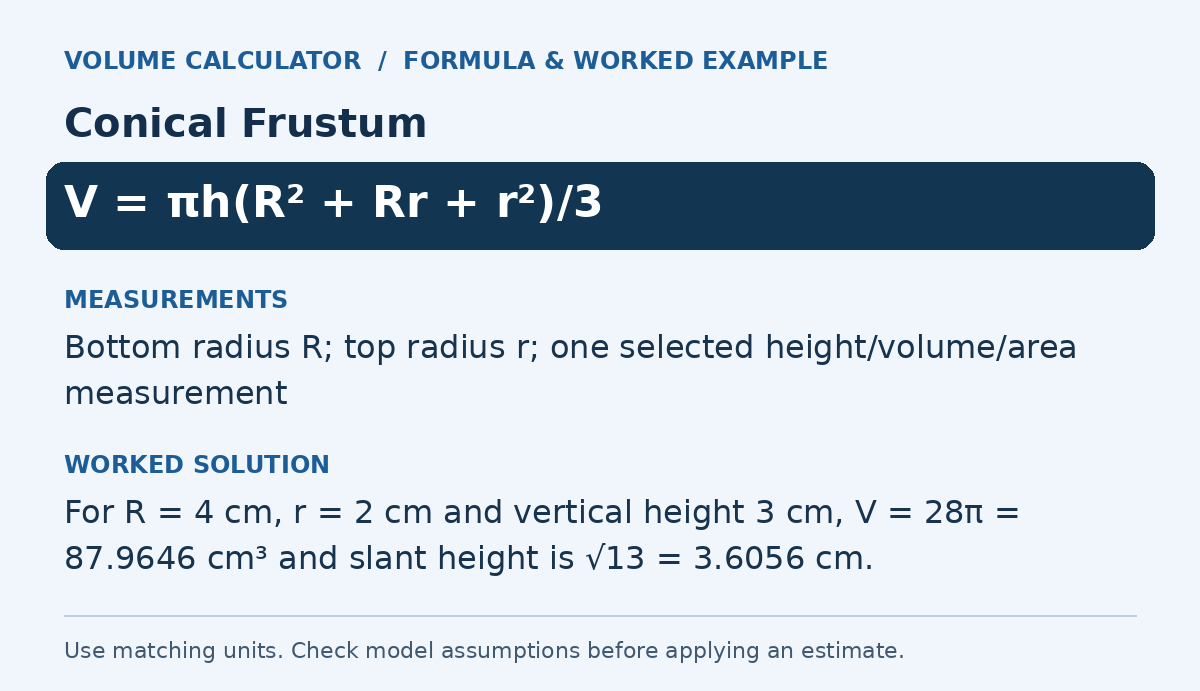
For R = 4 cm, r = 2 cm and vertical height 3 cm, V = 28π = 87.9646 cm³ and slant height is √13 = 3.6056 cm.
Available calculation options
These options match this page’s method controls. Selecting one changes the measurements or geometry used by the tool.
| Available option | Inputs / calculation |
|---|---|
| Vertical height | Use h directly. |
| Slant height | h = √[s² − (R − r)²]. |
| Known volume | h = 3V/[π(R² + Rr + r²)]. |
| Lateral surface area | s = A/[π(R + r)], then obtain h. |
| Total surface area | Subtract πR² + πr² from total area to obtain lateral area first. |
Assumptions and limits
Use parallel circular ends with R > r > 0 and positive height. The slant-height method requires slant height greater than R − r. Volume inputs use cubic units and area inputs use square units matching the selected length unit.
Inverse methods must describe a physically possible solid. A valid number is not enough: angles, triangle inequalities, radii and heights must also satisfy the selected geometry. The tool rejects invalid combinations.
Units and accuracy
Lengths use linear units, areas use squared units and volumes use cubed units. For example, 1 m³ = 1,000 L; 1 ft³ = 1,728 in³; and 1 yd³ = 27 ft³. US and imperial gallons differ, so use the correctly labeled output. A conversion does not improve measurement accuracy.
Keep unrounded measurements during the calculation and round the final result to suit the measurements. Very small nonzero results may use scientific notation to avoid displaying a misleading zero.
Questions about this tool
Why can my real measurement differ from the answer?
Use parallel circular ends with R > r > 0 and positive height. The slant-height method requires slant height greater than R − r. Volume inputs use cubic units and area inputs use square units matching the selected length unit.
Can I change the input units?
Choose the appropriate unit control and interpret each field as length, area or volume according to its label. Changing a unit does not automatically turn an outside measurement into an inside measurement.
How do I report an incorrect result?
Use Contact Us and include the page URL, selected method, input values, units and expected result. The contact form opens your email application; do not include sensitive information.
Available calculator controls
Enter each measurement in its own unit and choose a cubic or liquid output unit. For radius-based shapes, the diameter option converts the entered width to radius. The steps and diagram use the main input unit.
Copy the result, print the calculation or copy a calculation link to reopen the same measurements. The advanced panel can solve a supported missing dimension, add or subtract two simple solids, and estimate mass from a density you supply. Combined shapes must satisfy the stated overlap and containment assumptions.
Measurement question
Can a truncated cone volume calculator estimate a tapered bucket?
It can model a bucket with circular parallel ends and straight tapered sides. Use internal top and bottom radii and perpendicular height. Rounded corners, wall thickness and a non-circular opening can make actual usable capacity differ.
Summary
Use the truncated cone volume calculator to find conical frustum volume from compatible radii, diameters and height measurements.
- truncated cone volume calculator
- volume of a truncated cone calculator