
How to Calculate Volume: Step by Step
To calculate volume, identify the 3D shape, measure its required dimensions in one consistent length unit, and substitute those values into the matching volume formula. For a rectangular box, multiply length by width by height. For a cylinder, multiply the circular base area by its height. For a cone or pyramid, take one-third of the corresponding cylinder or prism volume.
- Choose the correct shape. A box, sphere, cylinder, cone and hollow pipe use different formulas.
- Measure the required parameters. Depending on the shape, you may need length, width, height, radius, diameter, base area or fill depth.
- Make units consistent. Convert inches to feet or centimeters to meters before calculating if dimensions differ.
- Calculate cubic volume. The answer is in cubic units such as in³, ft³, cm³ or m³.
- Convert if needed. For liquid capacity, use liters or gallons; for concrete, cubic yards or cubic meters may be more practical.
Example: A box 5 ft long, 3 ft wide and 2 ft high has a volume of 5 × 3 × 2 = 30 ft³. Its outside volume is not necessarily its inside storage capacity.
Volume Formula Chart for Common 3D Shapes
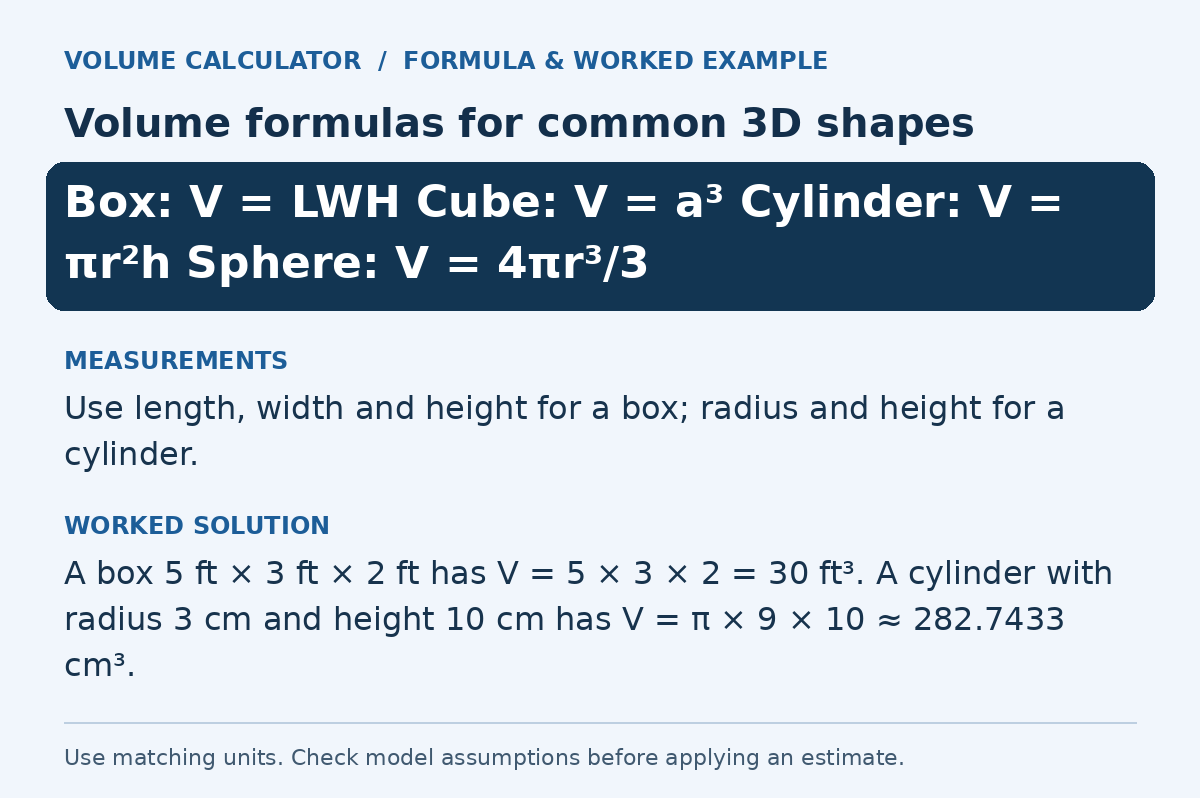
The general volume formula for a prism or cylinder is base area multiplied by perpendicular height. Other shapes use formulas that account for curvature or tapering. Use the chart below to find the volume equation for common solids.
| 3D shape | Volume formula | Measurements needed |
|---|---|---|
| Cube | V = a³ | Side length a |
| Rectangular prism / box | V = l × w × h | Length, width, height |
| Cylinder | V = πr²h | Radius, height |
| Sphere | V = (4/3)πr³ | Radius |
| Hemisphere | V = (2/3)πr³ | Radius |
| Cone | V = πr²h / 3 | Radius, perpendicular height |
| Pyramid | V = Bh / 3 | Base area B, perpendicular height |
| Triangular prism | V = (bh / 2) × L | Triangle base b and height h, prism length L |
| Hollow tube material | V = π(R² − r²)L | Outer radius R, inner radius r, length L |
| Ellipsoid | V = (4/3)πabc | Three semi-axes a, b, c |
| Conical frustum | V = πh(R² + Rr + r²) / 3 | Top/bottom radii, height |
| Torus | V = 2π²Rr² | Major radius R, tube radius r |
Notation: V is volume; π is approximately 3.14159265; r is radius; R may denote the larger radius; h is perpendicular height; and B is base area. A circle or square is a 2D shape and has area, not volume. “Volume of a circle” usually means the volume of a cylinder or sphere; “volume of a rectangle” usually means a rectangular prism.
Popular Volume Calculations and Worked Examples
Volume of a Cylinder Calculator
The volume of a cylinder is π times the radius squared times its height. With radius 3 cm and height 10 cm, V = π × 3² × 10 = 282.74 cm³. If you measured a diameter of 6 cm, divide it by two first. This cylinder volume formula is useful for cans, columns, tanks and other round objects.
Volume of a Sphere Calculator
The volume of a sphere is (4/3)πr³. For radius 3 cm, V = (4/3) × π × 27 = 113.10 cm³. The radius is the distance from the center to the surface, not the full diameter.
Volume of a Cube Calculator
The cube volume formula is side length cubed: V = a³. A cube with 4-inch edges has V = 4³ = 64 in³. All three dimensions must be equal for a true cube; otherwise use the rectangular prism calculator.
Volume of a Rectangular Prism Calculator
Find the volume of a rectangular prism by multiplying length, width and height. A box measuring 12 in × 8 in × 5 in has 480 in³ of outside volume. For a container's usable capacity, measure the inside dimensions instead.
Cone Volume Calculator
A cone holds one-third of the volume of a cylinder with the same base and height. A cone with radius 3 cm and height 10 cm has V = π × 3² × 10 / 3 = 94.25 cm³. Use vertical height, not slant height.
All Calculators Available in the Homepage Tool
The homepage calculator currently offers 41 selectable calculation types, covering geometric solids, tanks, pools, pipes, materials and special estimates. The following table reflects the options in the tool above, rather than claiming every shape uses the same inputs or provides identical outputs. Choose an option from “Choose a shape” to access its available fields.
| Available calculation | Formula or method | Use and need |
|---|---|---|
| Rectangular prism | Length × width × height | Boxes, rooms, cartons and storage spaces |
| Cube | Side³ | Equal-sided boxes and solid cubes |
| Cylinder | π × radius² × height | Cans, drums and round columns |
| Sphere | (4/3)π × radius³ | Balls and spherical vessels |
| Cone | π × radius² × height / 3 | Conical piles and funnels |
| Capsule | Cylinder + two hemispheres | Rounded-end containers |
| Spherical cap | πh²(3R − h) / 3 | Domes and spherical segments |
| Conical frustum | πh(R² + Rr + r²) / 3 | Tapered containers and hoppers |
| Ellipsoid | (4/3)πabc | Oval solids and estimates |
| Pyramid | Base area × perpendicular height / 3 | Pyramids with different base shapes |
| Hollow tube | π(R² − r²) × length | Tube wall material |
| Triangular prism | Triangle area × prism length | Wedges and triangular beams |
| Hemisphere | (2/3)πr³ | Half-spheres and domes |
| Rectangular tank | Inside length × width × height | Water tanks and aquariums |
| Truncated pyramid (square base) | h(A₁ + A₂ + √(A₁A₂)) / 3 | Tapered square-base solids |
| Truncated Cone Volume Calculator | Conical-frustum formula | Tapered cones |
| Hexagonal prism | Hexagon base area × height | Six-sided columns |
| Hexagonal pyramid | Hexagon base area × height / 3 | Six-sided pyramids |
| Octagonal pyramid | Octagon base area × height / 3 | Eight-sided pyramids |
| Trapezoid prism | Trapezoid area × length | Trapezoidal channels |
| General prism (known base area) | Known base area × height | Uniform-cross-section solids |
| Torus (donut shape) | 2π² × major radius × minor radius² | Ring-shaped solids |
| Pentagonal prism | Pentagon base area × height | Five-sided prisms |
| Vertical cylindrical tank | πr² × height | Upright tank capacity |
| Horizontal cylindrical tank (partial fill) | Circular segment area × length | Part-filled horizontal tanks |
| Swimming pool (average depth) | Surface area × average depth | Pools with varying depth |
| Irregular object (water displacement) | Final water level − initial water level | Small irregular solids |
| Pond | Pond area × average depth (estimate) | Garden ponds |
| Circular pool | πr² × average depth | Round swimming pools |
| Oval pool | Oval area × average depth | Oval pools |
| Irregular pool (area estimate) | Estimated area × average depth | Freeform pools |
| Pipe (material volume) | π(R² − r²) × length | Pipe wall material |
| Concrete Calculator | Project-dependent geometric volume | Slabs, footings, curbs and stairs |
| Soil Calculator | Area × depth | Garden beds and excavation |
| Gravel Calculator | Area × depth | Driveways and paths |
| Sand Calculator | Area × depth | Bedding and fill |
| Stone Calculator | Area × depth | Landscaping stone |
| Liquid container (rectangular) | Inside length × width × fill height | Rectangular liquid containers |
| Surfboard (estimated volume) | Shape-dependent estimate | Board displacement estimates |
| Subwoofer box | Inside enclosure dimensions | Speaker enclosure planning |
| Medical ellipsoid estimate | (π/6) × length × width × height | Ellipsoid-based educational estimate |
Choose the Right Volume Calculator for Your Project
Shape Volume Calculators
Shape calculators are best for solids that closely match a mathematical 3D figure. Choose a cylinder, sphere, cube, rectangular prism, cone, hemisphere, pyramid, triangular prism, spherical cap, frustum, ellipsoid, torus or another prism according to the object's geometry. Use the shape-specific page when you need more calculation methods or detailed explanations.
Tank Volume Calculators
A tank volume calculator estimates a tank's geometric capacity from its inside dimensions. Rectangular tanks and vertical cylinders have straightforward fill-height relationships. Horizontal cylinders need a circular-segment calculation for partial fill; a tank at one-quarter of its height is not necessarily one-quarter full by volume.
Pool and Pond Volume Calculators
Pool and pond volume is usually estimated from water-surface area multiplied by average depth. Choose rectangular, circular, oval or irregular pool options to suit the footprint. For a pool with a shallow and deep end, average depth can be a useful estimate when the floor slopes evenly. Actual capacity can differ because of steps, benches, curved walls and uneven bottoms.
Pipe and Tube Volume Calculators
Pipe capacity and pipe material volume are different measurements. Liquid capacity uses the inner radius: V = πr²L. Pipe-wall material volume uses the difference between outer and inner circular areas: V = π(R² − r²)L. Select the correct calculation for fluid storage versus material requirements.
Construction Material Volume Calculators
Concrete, soil, gravel, sand and stone calculators estimate how much material a project occupies. For a simple rectangular slab, multiply length × width × thickness after converting all measurements to the same unit. Concrete projects may also include round footings, curbs or stairs; choose the matching project type. Bulk material ordering may require an additional waste, compaction or settlement allowance, which is separate from geometric volume.
Liquid and Specialty Volume Calculators
Liquid-container and specialty calculators help with applications that a basic box or cylinder formula does not fully describe. The homepage also offers water-displacement measurement for irregular objects, a surfboard estimate, a subwoofer enclosure calculator and an educational ellipsoid estimate. Use specialized outputs with the assumptions shown in each tool.
Volume Units and Conversion Table
Volume is measured in cubic length units, while liquid capacity is often reported in liters or gallons. A cubic unit is the space inside a cube with edges one unit long. Convert only after the shape dimensions are consistent.
| Starting unit | Equivalent volume | Common use |
|---|---|---|
| 1 cubic meter (m³) | 1,000 liters ≈ 35.3147 ft³ | Construction and large tanks |
| 1 cubic foot (ft³) | 1,728 in³ ≈ 28.3168 liters | Boxes, soil and room space |
| 1 cubic yard (yd³) | 27 ft³ ≈ 0.764555 m³ | Concrete and bulk materials |
| 1 liter (L) | 1,000 cm³ = 0.001 m³ | Liquid capacity |
| 1 US liquid gallon | 231 in³ ≈ 3.78541 liters | US liquid capacity |
| 1 imperial gallon | 4.54609 liters | UK liquid capacity |
Example: A 30 ft³ rectangular container has approximately 30 × 7.48052 = 224.42 US gallons of theoretical internal capacity if those are its inside dimensions. Actual usable capacity may be lower.
How to Measure Volume Accurately
Accurate volume calculations start with accurate measurements and the right shape assumptions. Use inside dimensions for capacity and outside dimensions for overall object volume. Check whether a measurement is radius or diameter; the diameter is twice the radius. For a cone or pyramid, measure the perpendicular height rather than the slanted edge. For irregular objects, water displacement can give a direct volume measurement if the object can be safely submerged without absorbing water.
When estimating soil, sand, gravel or concrete, geometric volume is only the starting point. Do not assume material weight can be calculated from volume without a suitable density, or that a purchase quantity equals exact geometric volume. Check project specifications, local construction requirements and supplier guidance before ordering.
Common Volume Calculation Mistakes
- Mixing inches and feet: convert all dimensions before multiplying.
- Using diameter instead of radius: this can make a cylinder or sphere result much too large.
- Confusing area with volume: square feet describe a surface; cubic feet describe space.
- Using outside measurements for a tank: wall thickness reduces usable internal capacity.
- Ignoring partial fill or sloped bottoms: a horizontal tank and an irregular pool need appropriate methods.
- Rounding too early: keep full precision until the final result.
Frequently Asked Questions About Volume
What is volume?
Volume is the amount of three-dimensional space occupied by an object or contained within a boundary. It is measured in cubic units, such as cm³, ft³ and m³.
How do you find volume?
Find volume by measuring the dimensions required for a shape and using its formula. For a box, multiply length × width × height; for a cylinder, use πr²h.
What is the formula for volume?
There is no single volume formula for every shape. Prisms use base area × height, cylinders use πr²h, cones and pyramids use one-third of the matching prism or cylinder, and spheres use (4/3)πr³.
How do I calculate the volume of a cylinder?
Multiply π by the square of the cylinder's radius and then by its height. A cylinder with radius 2 m and height 5 m has 20π ≈ 62.83 m³.
What is the cube volume formula?
The volume of a cube is V = a³. Multiply its equal side length by itself three times.
How do you find the volume of a rectangle or square?
A flat rectangle or square has area, not volume. To find cubic volume, add a third dimension: a rectangular prism uses length × width × height and a cube uses side³.
How do you find the volume of a circle?
A circle is two-dimensional and has area, not volume. If you mean a circular cylinder, multiply the circle's area (πr²) by its height; for a sphere use (4/3)πr³.
How do you measure the volume of an irregular object?
Use water displacement when the object can be submerged safely. The increase in displaced water volume equals the submerged object's volume, subject to measurement accuracy.
How many cubic feet are in a cubic yard?
One cubic yard equals 27 cubic feet. Divide cubic feet by 27 to convert to cubic yards.
How do I convert cubic feet to gallons?
Multiply cubic feet by approximately 7.48052 to obtain US liquid gallons. Use the correct gallon standard because US and imperial gallons differ.
Does doubling every dimension double the volume?
No. Doubling all three linear dimensions makes the volume eight times larger. Volume scales with the cube of a linear scale factor.
What is the difference between volume and capacity?
Volume describes occupied space; capacity describes how much a container can hold. Capacity is usually calculated from inside dimensions and may be less than the container's outside volume.
Start With the Free Volume Calculator
Use the calculator at the top of this page to calculate volume for common shapes and practical projects. Choose from cylinders, spheres, cubes, rectangular prisms, cones, tanks, pools, pipes and construction materials, then explore the shape-specific calculator pages for additional methods, diagrams and step-by-step guidance. Always check the displayed formula and measurement assumptions before using an estimate for a purchase or engineering decision.
Available calculator controls
Enter each measurement in its own unit and choose a cubic or liquid output unit. For radius-based shapes, the diameter option converts the entered width to radius. The steps and diagram use the main input unit.
Copy the result, print the calculation or copy a calculation link to reopen the same measurements. The advanced panel can solve a supported missing dimension, add or subtract two simple solids, and estimate mass from a density you supply. Combined shapes must satisfy the stated overlap and containment assumptions.
Summary
Use this volume calculator for cylinders, spheres, cubes and boxes. Follow volume formulas and worked steps, then convert cubic units, liters and gallons.
- volume calculator
- volume formula
- how to find volume
- unit conversions