
Home / Pool & Pond Volume Calculators / Irregular Pool Volume Calculator
Irregular Pool Volume Calculator
Use the Irregular Pool Volume Calculator to estimate freeform pool water capacity using the selected area and depth method.
Volume Calculator
Select a 3D shape and enter its measurements.
Enter any two spherical-cap measurements. The calculator derives the third.
Enter both water-level readings using the same volume unit. The difference is the object's displaced volume.
For ft / in, enter values such as 5 ft 6 in. For m / cm, enter values such as 1 m 25 cm. You can also enter a decimal value in the larger unit.
Micrometers, nanometers and angstroms are available for very small-scale measurements.
Enter positive measurements. Results update when you calculate.
Calculate a result to rate this tool.
Multiply the length, width and height using the same measurement unit.
Step-by-step calculation
- Enter your dimensions to see the calculation steps.
Freeform pool formula and measurements
Freeform pool volume is calculated from selected pool footprint measurements; average water depth. V ≈ water-surface area × average water depth. Choose the relevant calculation method below and enter the measurements shown.
V ≈ water-surface area × average water depth
Required inputs: Selected pool footprint measurements; average water depth.
How to use this calculator
- Choose the calculation method that matches the measurements you know.
- Enter selected pool footprint measurements; average water depth.
- Select the appropriate units before interpreting the result. Keep length, area and volume units distinct.
- Select Calculate volume and review any error message, conversions and calculation steps.
- Check the result against the model assumptions below before using it for a project.
Worked example
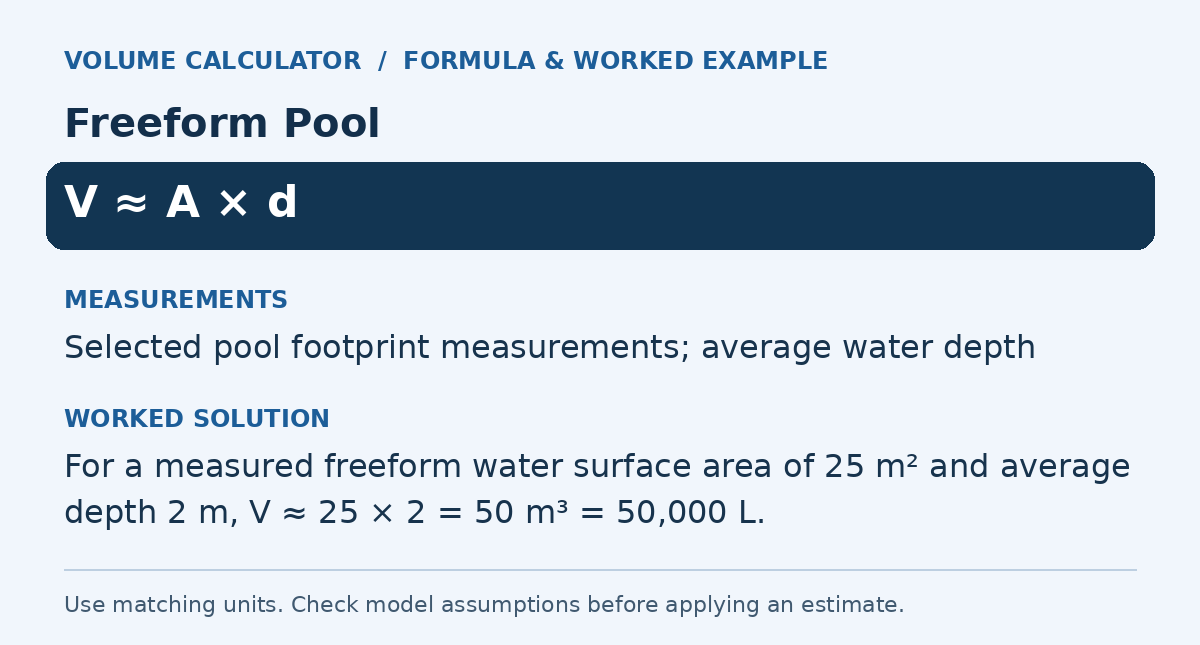
For a circular pool of diameter 4 m and average depth 2 m, volume is 8π = 25.1327 m³. For an oval 10 m × 4 m at average depth 2 m, volume is 20π = 62.8319 m³. For a measured freeform area of 25 m² at depth 2 m, volume is 50 m³.
Available calculation options
These options match this page’s method controls. Selecting one changes the measurements or geometry used by the tool.
| Available option | Inputs / calculation |
|---|---|
| Rectangular | A = LW. |
| Circular | A = π(D/2)². |
| Oval | A = πLW/4. |
| L-shaped | A = L₁W₁ + L₂W₂ for non-overlapping rectangles. |
| Kidney | Estimated A = 0.45(A_width + B_width)L. |
| Triangular | A = base × perpendicular plan height / 2. |
| Grecian | A = LW − 2c² for four equal 45° clipped corners. |
| Irregular (area estimate) | Enter measured/estimated water surface area A directly. |
Assumptions and limits
This page opens with the freeform option and also exposes the pool-shape selector below. Average depth must represent the actual water volume. Kidney and freeform models are estimates; steps, benches and irregular floors are not deducted automatically. For an L-shaped pool, enter non-overlapping rectangles. Grecian corner cuts must be less than half both overall dimensions.
Use average water depth rather than the deepest point. Using the average of shallow and deep ends is appropriate only when the floor slope and footprint justify it; irregular depths need a better area-weighted measurement.
Units and accuracy
Lengths use linear units, areas use squared units and volumes use cubed units. For example, 1 m³ = 1,000 L; 1 ft³ = 1,728 in³; and 1 yd³ = 27 ft³. US and imperial gallons differ, so use the correctly labeled output. A conversion does not improve measurement accuracy.
Keep unrounded measurements during the calculation and round the final result to suit the measurements. Very small nonzero results may use scientific notation to avoid displaying a misleading zero.
Questions about this tool
Why can my real measurement differ from the answer?
This page opens with the freeform option and also exposes the pool-shape selector below. Average depth must represent the actual water volume. Kidney and freeform models are estimates; steps, benches and irregular floors are not deducted automatically. For an L-shaped pool, enter non-overlapping rectangles. Grecian corner cuts must be less than half both overall dimensions.
Can I change the input units?
Choose the appropriate unit control and interpret each field as length, area or volume according to its label. Changing a unit does not automatically turn an outside measurement into an inside measurement.
How do I report an incorrect result?
Use Contact Us and include the page URL, selected method, input values, units and expected result. The contact form opens your email application; do not include sensitive information.
Available calculator controls
Enter each measurement in its own unit and choose a cubic or liquid output unit. For radius-based shapes, the diameter option converts the entered width to radius. The steps and diagram use the main input unit.
Copy the result, print the calculation or copy a calculation link to reopen the same measurements. The advanced panel can solve a supported missing dimension, add or subtract two simple solids, and estimate mass from a density you supply. Combined shapes must satisfy the stated overlap and containment assumptions.
Summary
Use the Irregular Pool Volume Calculator to estimate freeform pool water capacity using the selected area and depth method.
- Irregular Pool Volume Calculator
- freeform pool
- surface area
- water capacity